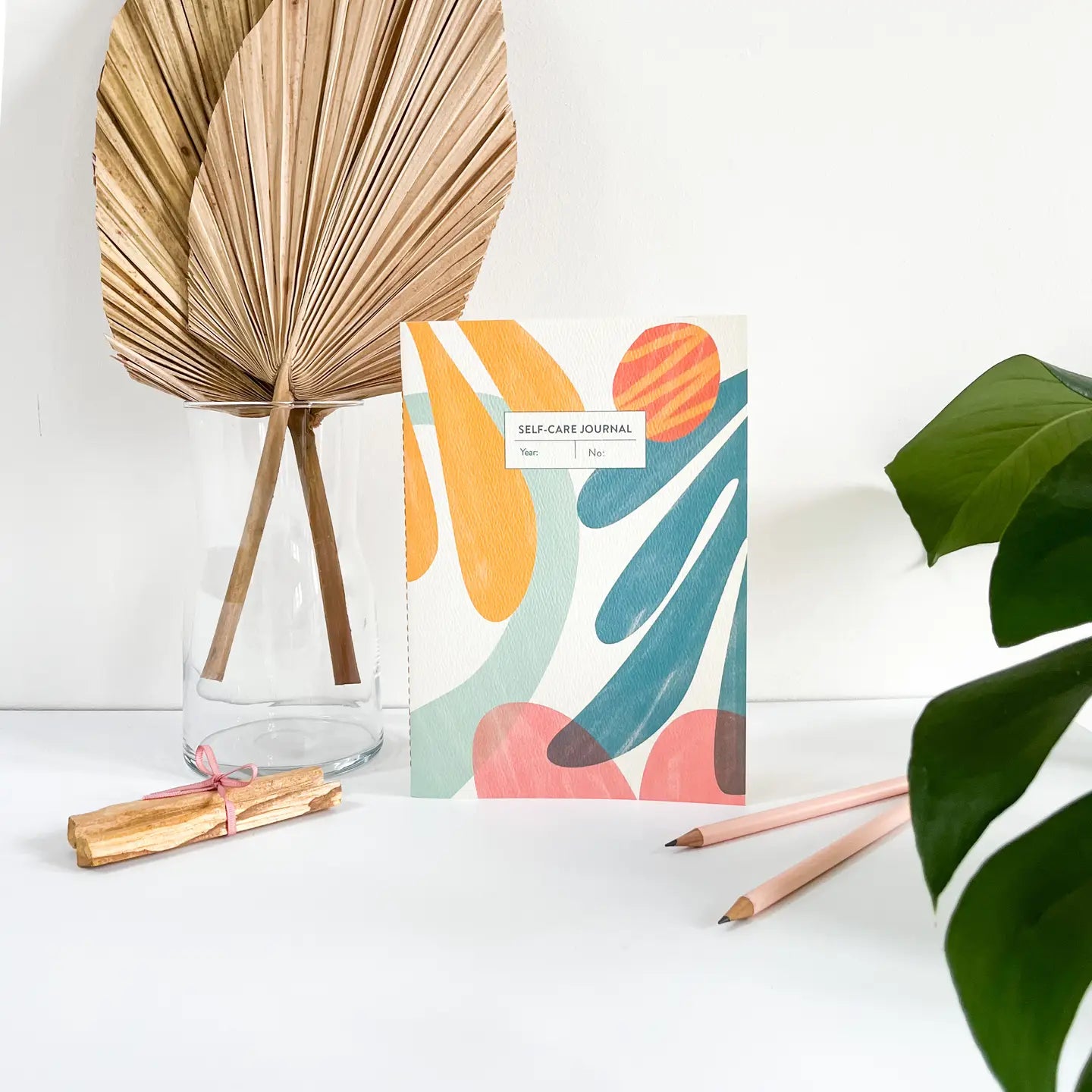


You've bought a beautiful notebook. You have a pen that writes far too nicely to use only for grocery lists. Maybe there's even a roll of washi tape next to you.
Now what?
Now you suddenly have to start journaling.
Don't worry. There's no exam, and no one will check if your pages are neat enough.
Journaling can be as elaborate or as simple as you want it to be. You can write half a page about your day every evening, or you can write three lines, make a list, or fill a page with stickers and scraps of paper you found too pretty to throw away.
The most important thing is simply to start.
What exactly is journaling?
Journaling is, simply put, keeping a personal journal. You write, draw, or paste things you want to remember, think about, or just like.
For some, it's a kind of diary. For others, a place to organize their thoughts. And still others use a journal mainly for lists, plans, photos, drawings, and small mementos.
So, there isn't one "right" way to journal.
And that's perhaps the beauty of it.
You don't have to be a writer. You don't have to write something every day. And you certainly don't have to create pages that look like they came straight from a perfectly styled Instagram account.
What do you need to start journaling?
Surprisingly little, actually.
A notebook and a pen are enough to start today.
Everything after that is just for fun.
1. A nice notebook
This is perhaps the most important part. After all, you're going to write in it.
Which notebook suits you best mainly depends on how you want to journal.
An A5 notebook gives you plenty of space for longer texts, lists, and creative pages. It's a great size if you want to journal at home or at your desk.
An A6 notebook, on the other hand, is small and easy to carry. Handy if you want to write on the go or just like having a compact book at hand.
And then, of course, you can also choose between:
-
lined paper
-
dotted paper
-
blank paper
Lines are pleasant if you mainly write. Blank paper gives you complete freedom to draw and paste. Dotted paper is a nice in-between: you have some structure, but the dots don't dictate what you should do with the page.
2. A pen you enjoy using
A good pen simply makes writing a little more enjoyable. A fineliner, for example, is pleasant for small texts and details. A gel pen writes smoothly and is good for longer passages. With a brush pen, you can play more with letters and accents.
And yes, of course, you can also just journal with the pen that's already on your desk.
It doesn't have to be a special journaling pen.
But once you find a pen where you think, oh, this one writes really nicely, there's a good chance you'll suddenly start making lists for everything.
3. Washi tape
Here begins the part that is not strictly necessary.
But it's a lot of fun.
Washi tape is thin decorative paper tape that you can use to decorate pages, stick down photos, mark sections of your page, or simply add a little color.
For example, you can create a border around text, stick a small piece of paper, or divide an entire page.
And the advantage of washi tape is that it's usually easy to remove. Handy for anyone who likes to be creative but after five minutes thinks:
"Hmm. I had something else in mind."

4. Stickers, journal paper, and other small finds
Stickers are also great for personalizing a journal.
Use them as decoration, to highlight certain topics, or simply because you have a sticker that you like too much to leave in its packaging.
And then there's journal paper. These are loose sheets with illustrations and patterns that you can use in your journal to give a page more character. You can use an entire sheet, cut or tear small pieces from it, or combine different prints.
The nice thing is that you don't immediately have to create a complicated collage. A small piece of paper next to a photo or under a piece of text can be enough.
At Drawables, for example, you'll find Claire Paul's journal paper, with various colorful patterns you can mix and match.
The same goes, of course, for small pieces of paper, tickets, labels, photos, or packaging.
A museum ticket from a fun day? In your journal.
Pretty packaging? In your journal.
A piece of paper that makes you think, this is actually too pretty to throw away? You guessed it.
That way, a journal automatically becomes a collection of small memories.

You don't have to make your journal beautiful
This might be the most important advice if you're just starting out.
You don't have to make beautiful pages.
The first page is often the hardest. Not because you don't know what to write, but because you suddenly feel like your first page needs to look like someone from Pinterest designed it.
It doesn't have to.
Your journal is yours.
A page with just text is fine. A page with a crooked title is fine. A page where you change color halfway through because you realize the first color wasn't that nice after all: also fine.
In fact, it's precisely those imperfect pages that ultimately make a journal personal.
What can you write in a journal?
Pretty much anything you want.
If you don't know where to start, try one of these ideas:
Write down three things that happened today
These can be big things, but small things are often fun to look back on later.
Note something that made you happy
A good coffee. A walk. A conversation. A song that was suddenly just right.
Make a list
A list of things you still want to do, books you want to read, places you want to go, or movies you still want to see.
Lists are, by the way, an excellent way to pretend your life is very organized.
Write down what you're thinking about
No structure, no fancy sentences. Just write.
Sometimes you only realize what you think about something once you write it down.
Create a page around one topic
For example:
My favorite places
Things I want to do this month
Music I'm listening to right now
Trips I still want to take
Things I don't want to forget
Such a page doesn't have to be full. A few words and a few small illustrations are enough.
Journaling with dotted, lined, or blank paper?
If you're looking for a notebook for journaling, you'll probably quickly come across different types of paper.
Lined
The classic choice.
Ideal if you mainly want to write and like some guidance on the page.
Dotted
Dotted paper consists of small dots that form a grid.
The dots give you subtle structure without filling your page with lines. This allows you to write, but also to create frames, lists, diagrams, and drawings.
It's no wonder dotted notebooks are popular among bullet journal enthusiasts.
Blank
No lines and no dots.
Complete freedom, therefore.
Blank paper is especially good if you want to combine writing with drawing, collages, or other creative forms.
Not sure which paper suits you? View our notebooks →
7 simple journaling ideas for beginners
Still don't know what to put on that first blank page?
Then try one of these:
1. Write about your day
What happened today?
2. Make a gratitude list
Three small things that made you happy.
3. Create a monthly page
What do you want to do, see, read, or try this month?
4. Make a list of favorites
Favorite books, movies, places, recipes, songs. Anything goes.
5. Stick something in
A photo, ticket, packaging, or piece of paper.
6. Fill a page with thoughts
No topic needed. Just start.
7. Start with one sentence
That's perhaps the easiest.
Write one sentence today.
Tomorrow you might write two.
And before you know it, you'll have a journal that, months later, turns out to contain an entire story.
What do you really need for journaling?
Basically:
A notebook.
A pen.
That's it.
A nice set of markers is fun. Washi tape is fun. Stickers are fun. A collection of different pens that you can never really write with all at once is also fun.
But you don't need them to start.
Just start with what you already have.
And if after a while you discover that you do want a beautiful roll of washi tape next to your journal...
Well. I can't do much about that, of course.
Journaling essentials from Drawables
Want to make your journal more personal? You can make it as elaborate as you want.
Notebooks — a good base for any journal.
Pens & fineliners — for writing, details, and small illustrations.
Washi tape — to give pages color and structure.
Stickers & paper goods — for small memories and decoration.
Markers — if you like to use more color.
Of course, you don't have to buy everything at once. Choose what suits how you want to journal.
Just start with the first page
Perhaps that's ultimately the only real advice I can give.
Don't wait until you have the perfect notebook. Don't wait until your handwriting is nicer. Don't wait until you know exactly what your journal should look like.
Grab a pen.
Open a page.
And write something down.
The rest will come naturally.
Frequently asked questions about journaling
How do you start journaling?
Start simply with a notebook and a pen. For example, write down what you experienced today, what you're thinking about, or what you want to do soon. There's no fixed way to journal.
What do you need for journaling?
A notebook and a pen are sufficient. Washi tape, stickers, markers, and other creative materials are optional and you can add them if you enjoy it.
Which notebook is suitable for journaling?
That depends on your preference. A5 offers plenty of writing space, while A6 is easy to carry. Lined paper is pleasant for writing, dotted paper offers more freedom, and blank paper is useful if you want to combine writing with drawing.
What do you write in a journal?
You can write about your day, thoughts, plans, memories, or things that make you happy. You can also make lists, add photos and tickets, or creatively decorate pages.
Do you have to journal every day?
No. Journaling doesn't have to be a daily obligation. You can write whenever you feel the need. A journal is not a planner, and there are no rules for how often you should use it.
